Episode 31 - Rounds & Partner Songs, Part 2 – Singing Around the World
Introduction
Welcome to Episode 31 of the Welcome to Music Podcast!
In this episode, Susie continues exploring the wonderful world of rounds and partner songs, part 2, with three very different musical experiences that take us around the world for 4-12 years.
We travel from Africa with Everybody Loves Saturday Night, to Japan with the delightful Kaeru No Uta (The Frog Song), before bringing four much-loved partner songs together in the Gospel Medley.
This follows the ‘Suite of Songs’ journey which includes echo and cumulative songs, call and response songs and will be continued and completed with partner songs and rounds.
These songs are fun to sing, but they also offer so much more. Songs that use these various techniques provide an inclusive setting allowing kids to have instant success, sing immediately (echo and call and response songs), easily dive into instant harmony with rounds and partner songs making singing in the classroom, in the choir and anywhere a great joy.
Why Rounds and Partner Songs?
Rounds and partner songs are a wonderful stepping stone between singing in unison and singing in harmony. In a round, everyone sings the same melody but begins at different times. In a partner song, two or more different melodies are designed to work together.
Both require children to listen carefully while maintaining their own part, helping to develop:
-
Pitch and vocal confidence
-
Listening and concentration
-
Musical independence
-
An understanding of harmony
-
Ensemble skills
-
Confidence in group singing
The secret is to start simply. Learn each melody really well in unison before attempting to put the different parts together. And most importantly, have fun with it!
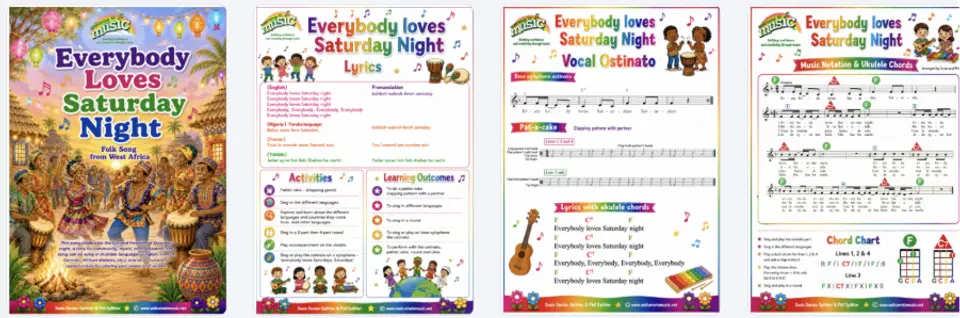
EVERYBODY LOVES SATURDAY NIGHT
Everybody Loves Saturday Night is a lively folk song associated with Nigeria and West Africa that has travelled around the world. The song became particularly well known internationally through American folk singer Pete Seeger, who sang it in many different languages. This transformed an already wonderfully repetitive song into a celebration of languages, cultures and people singing together. Its’ simple melody makes it very accessible for children and provides a perfect starting point for exploring rounds and multilingual singing.
🎶 Try it in your classroom
- Begin by singing the song together in English.
- Once the children are confident, try singing it as a two-part round, and then increase the number of parts as their confidence grows.
- You can also explore the song in different languages. This creates wonderful opportunities to talk about the many languages spoken within your own school community.
- Invite children or families to teach the class how to sing the song in another language.
What began as one little song can suddenly become a celebration of your whole community!
Learning opportunities
Use the song to develop:
-
Round singing
-
Pitch and vocal confidence
-
Maintaining an independent part
-
Beat and rhythm
-
Listening skills
-
Language awareness
-
Cultural understanding
-
Movement and dance
KAERU NO UTA – THE FROG SONG
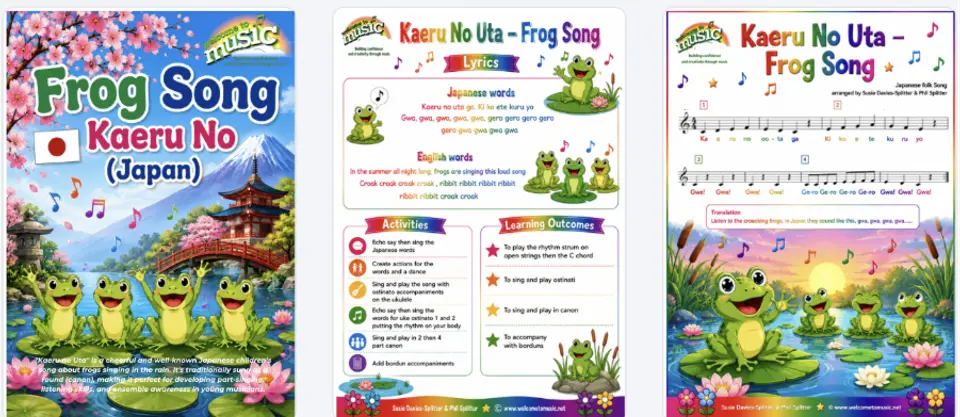
From Africa, we travel to Japan for one of its best-known children's songs. Kaeru No Uta, or The Frog Song, is a cheerful Japanese children's song about hearing the sound of frogs.
The Japanese words begin:
Kaeru no uta ga. Kiko ete kuru yo which can be translated approximately as:
‘The frog's song can be heard’ or ‘Listen, you can hear the frogs singing.’
The wonderfully playful sounds that follow imitate the croaking of the frogs.
Gwa, gwa, gwa, gwa. Gero, gero, gero, gero, gwa, gwa, gwa
Children often love these sounds, which makes learning a song in another language much less daunting! The song is also commonly sung as a round, with each group beginning the melody at a different time.
🎶 Try it in your classroom
-
Teach the Japanese words and melody first and sing the whole song together in unison.
-
Then add some frog actions or movement.
-
You could also introduce body percussion or non-melodic percussion instruments to accompany the frog sounds.
-
Once everyone can confidently sing the song, divide the class into two groups and try it as a round.
-
As confidence develops, add another group and listen to your classroom transform into a musical frog pond! 🐸🎶
Learning opportunities
Use Kaeru No Uta to develop:
-
Singing in another language
-
Round singing
-
Vocal confidence
-
Listening and concentration
-
Maintaining an independent part
-
Beat and rhythm
-
Movement
-
Body percussion
-
Instrumental accompaniment
-
Awareness of Japanese language and culture
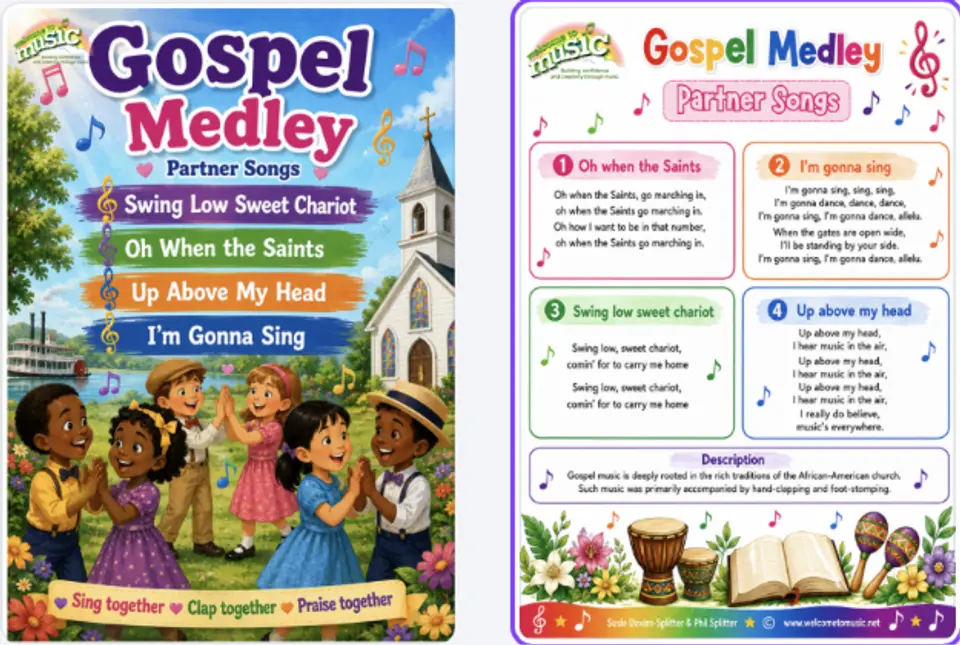
GOSPEL MEDLEY
Now it's time to take part-singing one step further!
Our Gospel Medley brings together four wonderful songs:
🎵 I'm Gonna Sing
🎵 Up Above My Head
🎵 Oh When the Saints
🎵 Swing Low, Sweet Chariot
Rather than singing the same melody at different starting points, as we do with a round, these songs can be brought together as partner songs. That means different groups can sing different melodies at the same time. It sounds fantastic when it all comes together!
🎶 Building the Gospel Medley
-
Don't try to put all four songs together straight away.
-
Teach each song separately and allow the children plenty of time to become really confident with each melody.
-
Add movement, body percussion or instruments and enjoy each song in its own right.
-
Then begin combining them.
-
Start with two songs.
-
Can each group maintain its melody while another melody is happening around them?
-
When that's secure, swap parts.
-
Eventually, you can build towards combining more of the songs and creating the complete Gospel Medley.
-
This is where children really begin to experience the thrill of independent part-singing.
From Unison to Harmony
One of the most important things to remember when introducing children to rounds and partner songs is that confidence comes first. If children are still trying to remember their melody, maintaining it while another group sings something completely different can be very challenging!
Build the skills gradually:
Unison → movement → body percussion → ostinato → two-part round → multiple-part round → partner songs
Give children lots of opportunities to hear, feel and experience their part before adding another. And don't worry if it falls apart occasionally! Sometimes the laughter when everyone ends up singing somebody else's part is half the fun. Simply start again and watch their musical independence grow.
Resources to Explore
In this episode we have explored:
🌍 Everybody Loves Saturday Night
A multilingual folk song that can be developed into a round.
🐸 Kaeru No Uta
A delightful Japanese children's song that's perfect for introducing singing in another language and singing in a round.
🎤 Gospel Medley
Four songs that can be learned separately before being combined as partner songs.
These resources can be used individually or as part of a broader unit exploring rounds, partner songs, harmony and part-singing.
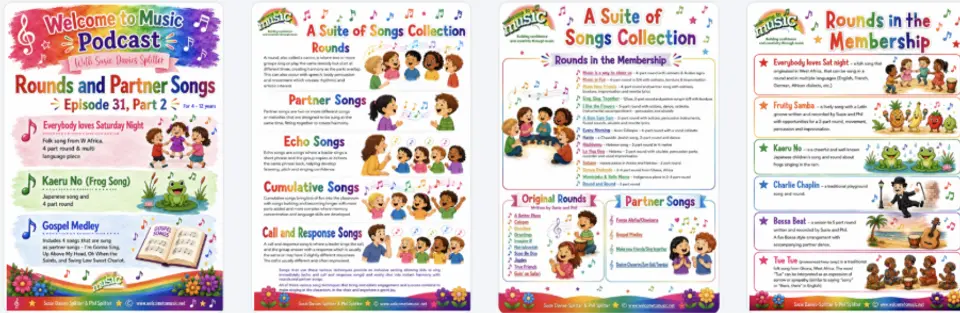
Explore the Suite of Songs
The songs featured in this episode are just the beginning! Our Suite of Songs brings together a colourful collection of rounds, partner songs, echo songs, cumulative songs and call & response songs, providing endless opportunities for singing, movement, part singing, percussion, improvisation and creative music-making.
Within the Welcome to Music Membership, you'll find a growing collection of rounds and partner songs from different cultures and musical styles, together with our own original songs and arrangements.
Each song can become the starting point for so much more than singing. Explore movement, dance, body percussion, instruments, improvisation, rounds, ostinati and part singing, with ready-to-use resources to help bring the music to life.
🌈 Discover the Complete Collection
Explore the Suite of Songs and access the complete resource kits in the Welcome to Music Membership. Try the Membership FREE for 7 days and start exploring!
🎶 Keep Singing!
Rounds and partner songs give children the opportunity to experience something quite magical: hearing completely different musical parts happening around them while confidently maintaining their own.
And the songs in Episode 31 remind us that music can also take us around the world.
From Africa to Japan and through the rich tradition of gospel and spiritual songs, each brings its own language, history and musical character, while giving children the shared experience of making music together.
We hope you enjoy exploring these songs with your students.
LEARN MORE ABOUT THE WELCOME TO MUSIC MEMBERSHIP
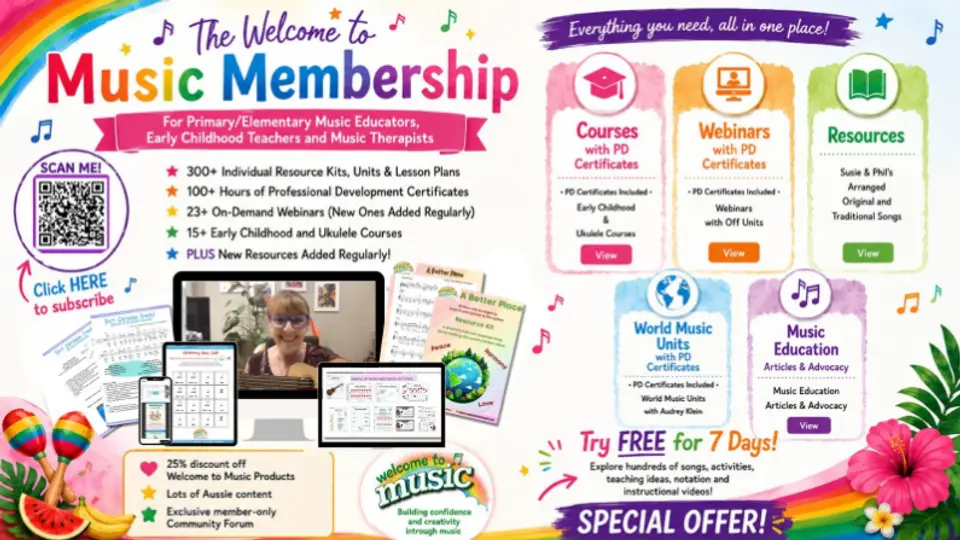
Imagine having a treasure trove of resources designed to make your teaching journey a breeze. The Welcome to Music membership is your ultimate toolkit for primary/elementary music educators, early childhood teachers, music therapists and anyone that uses music with children 0-12 years. Here’s what is inside:
✨ 100+ Hours of PD Certificates: Dive into our extensive library of on-demand courses and webinar replays, earning professional development certificates at your own pace.
🎤 Library of Webinars and Workshops: Unlimited access to our complete collection of webinars and workshops, packed with resources including topics such as: Bucket Drumming, Instruments in the Classroom, Games, Performance Ideas, Indigenous songs, Lilting lullabies & tranquil tunes, Story Songs, Folk Dances, World Music and many more, all with PD certificates
📚 Ready-Made Resource Kits: Over 250 lesson plans, activity sheets, and teaching resources to save you hours of prep time, including complete music notation with songs, dances, choral music, percussion arrangements, recorder pieces, ukulele accompaniments, music reading worksheets, arts and crafts, links to the curriculum and assessment and much more
💻 On-Demand Courses: Interactive courses covering everything from Music with Babies & Tots, Early Childhood Music to Advanced Ukulele!
👨🏫 Exclusive, Community Forum and member-only private Facebook group: Connect with a vibrant community of educators, share ideas, and receive continuous support from Susie, Phil, and the team.
💡 Always Fresh Content: New resources added regularly, and all webinars available shortly after they go live!
🦘 Lots of Aussie Content: A huge and growing collection of Susie and Phil’s original and traditional songs with added resources and instructional videos alongside resources from other notable Australian music and movement educators
🈹 25% Member Discount off Welcome to Music products: All members receive 25% off any physical or digital products (excluding Black Belt Ukulele products) in the Welcome to Music Store! https://welcometomusic.net/
Become a member of the Welcome to Music community today and enjoy all these fantastic benefits. Visit our Membership Page
Closing
This podcast has been brought to you by Welcome to Music – building confidence, creativity and enriching lives through the joy of music. In the show notes, you'll find links to a summary of this episode and our social media platforms. In the blog, you will find all the notes and links to this episode.
Our goal is to help make teaching and learning music easy and fun for all. I use an inclusive, multi-modal, multi-sensory and Orff-based approach to help make the learning stick.
- Find us at https://welcometomusic.net/
We would love you to subscribe to our YouTube channel where you can find almost 200 videos for kids – from lyric, play-along, instructional and animation videos www.youtube.com/c/WelcometoMusicSP
- Find 100’s of our songs on streaming platforms such as Spotify and Apple Music – just search for Susie Davies-Splitter & Phil Splitter or the song title
- Join us in the socials on Facebook and Instagram
Click the Links Below to Find Us on the Socials:
Click the Links Below to Find Our Music on These Platforms:
If you have enjoyed this podcast, please share it with others and leave a review – I’d really appreciate it.
Happy music-making! 🌈🎶
Susie & Phil, Welcome to Music
Episode 30 - Rounds & Partner Songs, Part 1 – Singing Around the World